The pension lands every month in an account you can no longer log into. The app wants a code. The code goes to a phone number that stopped working the day you emigrated. There is no branch on the continent. You are eighty, you are solvent, and you cannot reach your own money.
This is not a glitch. It is the system behaving exactly as built. In 2019 a group of security researchers asked why older adults do not adopt two-factor authentication and answered it in their title: Because They Are Excluded by Design. The phrase the paper turns on is colder than the title. Older adults, the authors wrote, are “caught in a negative feedback loop where lack of adoption prevents availability, and vice versa.” The bank builds a security step for the median user. The old user cannot complete it, so they abandon it. The bank reads low adoption and never builds the accessible alternative. The loop closes. Exclusion is not a decision anyone made. It is what the design produces on its own.
The remittance-dependent, fully-digitised expat is the precise profile that loop is built to fail. And the relocation pitch sold it to them as the upside.
The mechanism has a name
Read the Das paper’s method before the conclusion, because the method is the argument. The researchers sat with older adults and ran think-aloud protocols, watching a person try to use the thing and listening to them narrate it. The security tokens were “very small form factors; nearly invisible in a purse”, device- and browser-dependent. The friction was not the user’s incompetence. It was a design that assumed a user the participant was not.
Stack the layers the way a bank actually stacks them. A password you have to recall. A second factor: a code texted to a phone, or an app that generates one. A biometric, the fingerprint or the face. App-only access, because the branch is gone. Each layer, in isolation, tests fine against a forty-year-old. Together, against an eighty-year-old, they compound, and every added gate is another point at which the trajectory bends toward abandonment. The bank sees the aggregate adoption number and concludes the old simply prefer the branch. The negative feedback loop does the rest.
That is the domestic case, the one the literature measures. The expat case takes the same architecture and removes every fallback it quietly relied on.
The adoption gap is age-graded
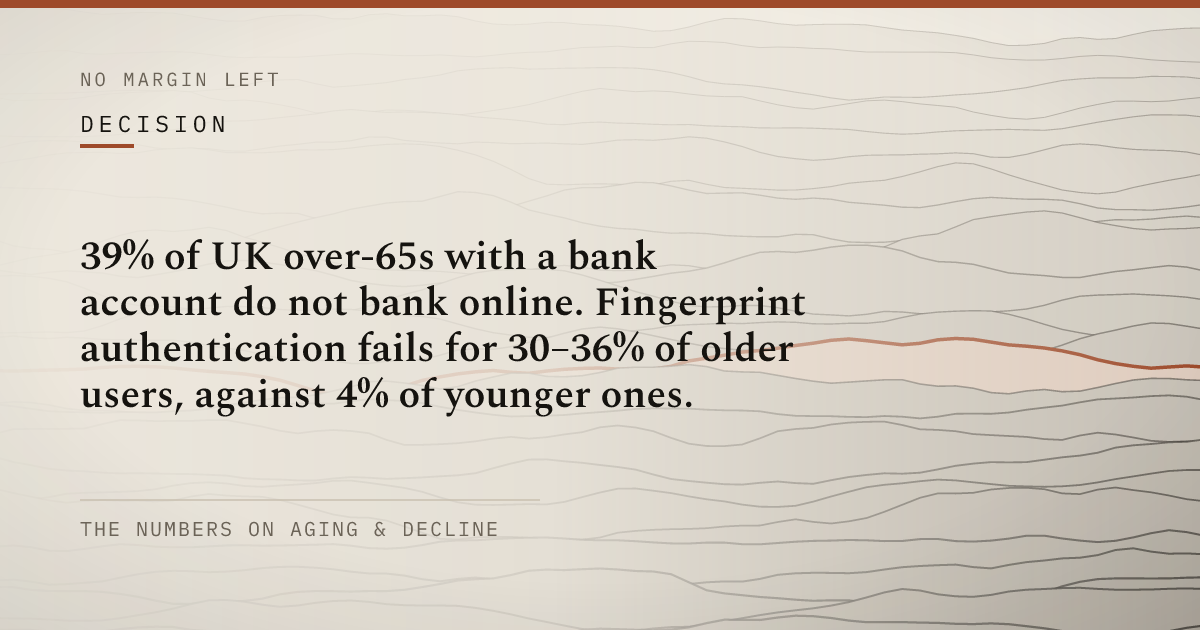
The gap is not anecdotal and it is not small. Age UK’s 2023 report You can’t bank on it anymore found that 39% of over-65s in Britain with a bank account — 4.09 million people — do not manage their money online at all. Nearly a third, 3.25 million, said they were uncomfortable with online banking: 31% afraid of fraud, 28% not trusting the service, 28% lacking the IT skills. Three-quarters of over-65s want to do at least one banking task in person. Among the 85-plus, only about one in seven banks online.
Hold those figures against the relocation brochure, which assumes the opposite reader: digitally fluent, app-first, branchless by choice. The brochure is describing the sixty-year-old at the moment of the move. The figures describe the same person twenty years on. The wider backdrop points the same way. The FCA’s Financial Lives reporting puts the digitally excluded UK adult population near 1.2 million in 2024, around half of them aged 75 and over, though those headline counts come from summary reporting rather than a page I could confirm, so treat them as context, not as the load-bearing number. The load-bearing number is Age UK’s, and it points the same direction: capability with digital banking falls with age, on a curve the system does not accommodate.
The app and the face that no longer matches
The biometric was supposed to be the accessible answer — no password to recall, just your finger or your face. It ages worse than the password.
A fingerprint-based mobile authentication system showed an equal error rate of 30.4–35.8% for older users, against 95.7% accuracy for non-elderly ones; facial recognition ran a receiver-operating-characteristic of 77.0–83.0% for older adults versus 99.2–99.6% for the young, per the figures assembled in a 2026 study of older adults and biometric payment, citing Blanco-Gonzalo, Wang, Galbally and others. Fingerprint impression quality is the lowest of any age group at 70 and above. The causes are physiological and unfixable by tutorial: worn ridges, dry or damaged skin, limited facial expressiveness, the loss of dexterity. The face genuinely no longer matches the enrolment. The finger no longer reads.
And when the biometric fails, it falls back. It falls back to the one-time passcode. Which, for the expat, is the step that also fails.
The fallback that no longer exists
There is a reason older domestic customers tolerate the digital gates: the branch and the phone line behind them. When the app locks, there is a building with a person in it who can recognise you. That fallback is being demolished. More than 6,600 UK bank branches have closed since January 2015 (around 53 a month, 410 in 2024 alone), nearly 68% of the network that existed a decade earlier, per the House of Commons Library briefing on access to cash and banking. The analogue exit is being removed at exactly the moment the digital entrance becomes mandatory.
For the expat, the fallback was never there to begin with. The branch is a continent away. The phone line routes to a domestic number on hold music the international call drops. The person who could walk in and vouch for you — an adult child, a sibling — is the relationship the move put on the far side of a long-haul flight. The domestic elder loses a fallback. The expat emigrated past it.
The digital-exclusion stack
Here is the synthesis the brochures cannot show, because every row in it is a thing that does not appear in a photograph of a pool. Take the six banking touchpoints the remittance-dependent expat actually depends on. For each: the access barrier that age creates, why the expat case is strictly worse than the domestic elder’s, and the structural fix that has to be set before the capability gap, not at the moment of lockout.
| Touchpoint | The age barrier | Why the expat case is worse | The pre-emptive fix |
|---|---|---|---|
| Home-bank login (password + 2FA) | The age barrier A recalled password plus a second factor the older user abandons — "excluded by design" | Why the expat case is worse 2FA tied to a lapsed home number; the bank blocks the code from an unusual location | The pre-emptive fix In-app authenticator (TOTP) on a trusted device; a number the bank will actually text |
| SMS one-time passcode | The age barrier The code arrives on a phone the user struggles to operate under time pressure | Why the expat case is worse Banks commonly will not SMS international numbers; the home SIM lapsed at emigration | The pre-emptive fix Keep a live home number (roaming/eSIM) or move off SMS to an authenticator app |
| App + biometric (fingerprint/face) | The age barrier Fingerprint error 30–36% vs 4% younger; face 77–83% vs 99%; worst at 70+ | Why the expat case is worse The failed biometric falls back to the SMS-OTP that also fails | The pre-emptive fix A non-biometric login path kept live; a device that stays enrolled |
| Card re-issue to a home address | The age barrier An expiring or replacement card is the most common access break | Why the expat case is worse The home address on file is gone or borrowed; cards are not couriered abroad | The pre-emptive fix A controlled home care-of address the bank recognises, set before the move |
| Fraud-hold phone verification | The age barrier A hold cleared only by answering a call and security questions under stress | Why the expat case is worse Foreign transactions trigger the hold; not answering can read as proof of compromise | The pre-emptive fix Pre-notified residence status, a reachable number, a known second contact on file |
| Pension-deposit account | The age barrier The income lands in an account 39% of over-65s already cannot operate online | Why the expat case is worse The one account the whole income depends on is the likeliest to lock; no branch near | The pre-emptive fix A fallback signer / recognised power of attorney, plus a second receiving rail |
Source: Das et al. 2019 (PMC6840946); Age UK 2023; arXiv 2601.12300; Commons Library CBP-9453; expat-banking guidance (The Prepared Expat, Experts for Expats) · checked 2026-06
Read the middle column on its own. Every entry is the same sentence in a different costume. The analogue fallback the domestic elder still has, a live number and a recognised address and a near relative and a branch, is the thing the move removed. The right-hand column is the entire decision, and notice when it has to happen. Not one of those fixes can be installed at the moment of lockout. By then the number is dead, the address is gone, and the capacity to set up an authenticator app may itself be the thing that has slipped.
Now the proxy flag, stated plainly because it is load-bearing and not a hedge. Every figure in that table is Western and domestic. Age UK measured British over-65s. The biometric studies measured general older populations. The branch count is UK. There is no measured rate of Western expats in Thailand or the Philippines being locked out of their banks, and there is no honest way to invent one. None. What transfers is the mechanism, security built for the median user excludes the old one, and the concrete expat stack that compounds it on every axis. The magnitude is unmeasured. The structure is not in dispute.
Why the expat case is worse
Take the worsening axis by axis, because the compounding is the whole point.
The domestic elder who forgets a password walks into a branch and shows a face a teller half-recognises. The expat’s branch is in another country. The domestic elder whose card expires gets the replacement in the post. The expat’s card re-issues to an address that is no longer his, and banks do not courier cards abroad. The domestic elder whose account triggers a fraud hold answers the call and the questions. The expat’s foreign transactions are why the hold fired, and his inability to answer a call routed to a dead home number can be treated as confirmation the account is compromised, which freezes it. The reports are consistent and first-hand: expats locked out by 2FA bound to a number they gave up, banks refusing to text codes internationally, verification calls that cannot be answered read as proof of fraud.
These are category mechanics, not an accusation against any one bank. The same security architecture that makes the account safe for the median customer makes it unreachable for this one. The fraud control built to protect him is the lock.
Trace the realistic cascade, because no single step in it is exotic. The card on file expires; the replacement goes to a home address that is no longer his, and never arrives. He tries the app to check; the app has logged him out and wants the second factor; the code goes to the home number he let lapse two years ago. He cannot log in, so he cannot update the number from inside the app, which is the only place the bank lets you update it. He phones; the line wants a code, or security questions answered against records he set up decades ago and half-remembers. None of it is malice and none of it is rare. Each gate is reasonable in isolation. The cascade is what the gates produce when the person behind them is eighty and a continent away, and the cascade ends with the income landing, on schedule, in an account no one can open.
The fraud hold that locks the funded account
The fraud hold deserves its own beat, because it is the failure that catches the careful planner.
You did everything the brochure said. You kept the home account open, you bank from the app, you moved your life. Then a routine payment from your new country looks anomalous to a model trained on your old life, and the bank freezes the account pending verification. Verification is a phone call. The phone call goes to the number you left behind. You do not answer, because you cannot. The model now has its confirmation: legitimate customers answer; this one did not. The hold hardens into a freeze. The pension keeps landing in the frozen account, untouchable, every month, on time.
This is the same structural trap that runs through the rest of this work. The bank-account survival checklist covers the FATCA and CRS layer that gets accounts closed; this is the quieter sibling, the account that is never closed and never reachable. It compounds with the failures next door: the incapacity-paperwork trap, where no one holds the authority to act when the holder cannot, and the mild-decline peak-risk zone, where the window of greatest financial vulnerability opens early, before any diagnosis, while the holder still looks fine and the capacity to set up a fallback is already eroding.
The local account is the same architecture, in a second language
Everything above is the home-country side. The local account, the one the expat opens on arrival to hold baht or pesos for daily living, runs the same architecture, and adds a barrier of its own.
Thai mobile banking requires a Thai phone number for the OTP. The setup every guide recommends is to open a Bangkok Bank or Kasikorn account, get a Thai SIM, and link the app to that number. Login is a PIN inside the app; transactions and PromptPay registration push a one-time code by SMS to the Thai number. K-PLUS and the Bangkok Bank app are, for most practical purposes, the only door: the counter that opened the account is increasingly not staffed to operate it. The same is true across the region’s retail banks as they push customers onto apps. So the local account inherits every failure mode of the home account, with three additions.
The first is the local SIM itself. The Thai-number OTP works only while the number is live, which means a prepaid SIM topped up on schedule or a postpaid line kept current. An eighty-year-old who misses the top-up, or a recovering patient whose SIM expires during a hospital stay, loses the number and with it the login. The number was never a possession. It was a subscription with a quiet expiry.
The second is the language. The app that gates the account is in Thai by default; the English layer is partial and the fraud-and-verification flows are the least translated part. The negative feedback loop the Das paper described runs harder here, because the user is excluded by design and by language, and the two compound. A capability slip that a domestic user would push through becomes a hard stop when the screen that has to be read is in a script the user never learned.
The third is recourse. When the home-country app locks, there is at least a regulator, an ombudsman, a complaints process in the user’s own language. When the local app locks, the recourse is a branch visit conducted in Thai or Filipino, often requiring the passport and the visa documents the holder may no longer be able to assemble, in a system with no obligation to accommodate a foreigner’s decline. The local account is not safer for being closer. It is the same gate with the analogue exit bricked up harder.
The decision is structural and it is early
The relocation pitch sells app-only, borderless, branchless banking as pure convenience: manage your money from anywhere, no queue, no paperwork. That convenience is real at sixty. It is the same architecture that locks the funded account at eighty, in a place with no branch on the continent and a code going to a phone that died at the airport. The benefit is front-loaded. The bill arrives at the end, in the place where the fallback was deliberately removed.
So the decision is not a SIM tip applied in a crisis. It is structural, and it has to be made while it is still obviously you making it. A number the bank will actually reach. An authenticator app on a device you keep, so the login does not ride on one text to one handset in one country. A controlled home address the bank recognises. A second receiving rail for the income, so the pension is not a single point of failure. And a fallback signer, a power of attorney the institution will actually honour, set up before the capacity to set it up is the thing in question.
The man who cannot reach his own money at eighty is not careless. He is the median customer, twenty years on, in a place that removed every door but the one he can no longer open. He set it up himself, on purpose, at sixty, and called it freedom.