The Carer You Married
US spousal caregivers logged 44.6 hours a week. Metro Manila sets a wage floor, a rest day and a pension for exactly that job — for the hired stranger, never the wife.
Every published piece — 104 in all — filed by section. Start with the spine, or read by what you are afraid of.
104 pieces
The hard numbers — the math, the base rates, the costs.
US spousal caregivers logged 44.6 hours a week. Metro Manila sets a wage floor, a rest day and a pension for exactly that job — for the hired stranger, never the wife.
Widowed men aged 65–69 carry a 70% higher mortality hazard in the year after loss; women, 27%. The younger-wife plan maximises the man's exposure.
US reported fraud losses by the 60+ rose 300% to $2.4B in four years, and the median loss climbs with age to $1,650 past 80. The isolated expat is the target.
Alcohol was the leading identified cause of Thailand's 119,464 chronic-liver-disease hospitalizations, at 30.8%: more than hepatitis B and C combined.
In SE Asia the binding vehicle is the scooter, not the car. The day age takes it away, a measured cascade starts: long-term-care placement, depression, mortality.
At age 80, 1-year mortality after hip fracture is 30% all-cause for a Western male. With dementia it is 39%. The Bangkok package excludes the implant. The medevac you bought doesn't fly for 6 weeks post-op. The actuarial trajectory.
Older motorcyclist case-fatality climbs from 0.5% at 65–69 to 1.7% at 85+, a 3.4× rise. The crash you survive at 60 kills you at 80, on the SE Asian scooter.
WHO 2023 baseline ×2 foreigner factor ×2.5 age vulnerability: a 67-year-old UK scooter rider in Thailand carries ~53× home-country road-death exposure. The arithmetic, not the warning.
The classical 35°C wet-bulb ceiling is a young body. The older compensable threshold is 28.5°C. Bangkok breaches it in April. The pension brochure prices none of this.
Thailand's male suicide rate is higher than in any of the four countries these men most often come from. It peaks in the thirties and ends, past seventy, below its own average. The cliff is real; it is not Thai.
What an ischaemic stroke or acute coronary syndrome actually costs the uninsured Western expat at the top private hospitals in Bangkok and Manila — and why "I will just fly home" prices the wrong country bill.
Chiang Mai's air runs 3.6x the WHO limit year-round and the world's second-worst in season. Priced as a chronic dose, it costs over a year of life.
Living alone raises mortality risk by a third, and the most exposed cohort abroad is the one no dataset counts. The sourced mechanism, stated cold.
No agency counts how many retirees stay, so model it: 100 arrivals decay to 54 in place at 75, 18 at 85. The stay-curve, with its bands stated.
One legally mandated dataset of deaths abroad exists, and by statute it excludes the death the aging expat is likeliest to have. The sourced count.
At 65, a regional health plan costs a seventh to a quarter of what an international one does. The Philippines-vs-Thailand gap is real locally and gone globally. Sourced.
Healthcare costs in the Philippines climb 16% a year, in Thailand about 11% — both far above CPI. The trend rate, not today's cheap bill, decides whether the plan survives to 80.
There is no single 'FX decline' but a currency-by-country matrix, and one cell has no defence. The 18-year carry of a sterling and a dollar pension.
Two identical UK pensioners, two Southeast Asian countries, one pension frozen for life. The sourced decade of what the freeze has already cost.
No agency counts how many Western retirees leave Thailand or the Philippines. The silent cohort, triangulated from three directions, uncertainty stated.
Expat health cover is cheap while you don't need it and fails when you do. The cross-insurer age curve, and the year the premium overtakes the pension.
The retire-abroad budget is a snapshot sold as a trajectory. A transparent 25-year drawdown model, every assumption shown, the year the margin hits zero.
Insurance age-out, long-term care, and dying abroad.
A Thai nursing-home bed is sold from THB 15,000 a month. That tier buys a shared room and a caregiver, no nurse. The three-band standard ladder, costed.
Bangkok hospitals publish their cancer surgery prices. Nothing in Thailand or the Philippines publishes the chemotherapy, and that is where the bill is.
Skip routine screening and your odds of an advanced-stage cancer diagnosis rise ~78% (OR 1.78). The move abroad removes the recall system that screens you — and stage decides survival.
A census of 803 published Thai hospital packages: 236 check-ups, 116 vaccines, zero for dialysis, chemotherapy, an ICU day or a bed. Both countries require publication.
Most people with clinically significant hearing loss never buy the aid. The endurance gap, and why the un-bought device feeds the isolation-to-depression cascade abroad.
Scam and financial-exploitation vulnerability peaks in early, mild cognitive decline, not severe. It is an inverted-U, and the peak is the window no one catches.
The aging expat fears the scammer and the stranger. The elder-abuse data says the most common perpetrator is family, and the most common harm is financial.
The US, UK and Australian governments pay nothing to repatriate your remains, and the US consul is legally barred from your bank account. The void, sourced.
Lancet 2022: 80% of the world dies without palliative care or morphine. The morphine gap, the named charitable hospice capacity, the private-ICU dying-week bill, and the advance-directive matrix for the expat who chose to die abroad.
End-stage renal disease is a self-pay bill no expat policy renews into. A model from eGFR decline to the year the kidney and the money both expire.
A sourced, cross-city table of standard private and ICU room rates: Bumrungrad ICU THB 25,500, Raffles SG ICU SGD 938, Lam Wah Ee Penang ICU MYR 320. And why the rate card is 25 to 35% of the actual bill.
The IPMI brochure says renewable to 99. The renewal letter, after a Type 2 diabetes diagnosis at 62, says four things instead. None of them say the brochure was wrong.
Verified 2026 air-ambulance route prices, what IPMI evacuation cover actually does (Singapore, not home), the age curve that thins at 75 and dissolves at 85, and the line where evacuation is the wrong call.
Chiang Mai dementia care at $2,300-4,300/month is a snapshot of a curve. Statutory floor, nurse shortage, domestic demand, and the absence of insurance backstop projected to 2035.
Thailand’s O-A retirement visa requires a policy the market is least willing to write. The OIC-approved insurer × age × certificate matrix, and what the renewal week actually looks like at 71, 74 and 76.
A younger wife lowers a husband's mortality by about 11%. The same study finds she pays for it in her own life expectancy. The actuarial case.
Medicare pays nothing where you live but still bills $202.90 a month; the NHS ends the day your move is permanent. Two systems, two failure modes, sourced.
The O-A visa is not a one-time hurdle but a three-gate solvency re-test run every year for life, each gate hardening with age. Decomposed and costed.
Widowed men carry a mortality hazard around 1.27, peaking near 1.41 in the first six months. Abroad and alone, every buffer the figure assumes is gone.
The embassy-hosted quote to fly a body home from Thailand is about 100,000 baht. The UK funeral trade's own long-haul ranges start at £5,000, before the funeral. The repatriation runbook, costed by leg, under a 30-day clock.
The isolation-to-dementia science is settled; the living-alone risk is documented. The move abroad raises that risk and removes the detection.
A live-in carer in Thailand or the Philippines costs under US$600 a month. The number is real, and it answers the wrong question. The care ladder, costed.
Cheap care is a per-month number. What ends estates is duration: a multi-year dementia trajectory, paid uninsured, with no one to hold the tier down.
A Thai private hospital wants 50,000-200,000 baht in cash before it treats you. The cost ladder of one uninsured emergency, and the medevac tail beyond it.
Rejection at 75 starts a forced choice among four paths, one of them deliberate uninsurance in the highest-risk decade. The matrix, costed.
Sixteen expat insurers, one question: until what age will you write a new policy, and until what age will you keep me. Answered only from their own pages.
What relocation does not fix — the ideas behind the numbers.
Thailand caps permanent residence at 100 per nationality a year. In 2019 it granted 255, to everyone. On its own counts the cap is not what stops anyone.
Aging abroad without family scaffolding resolves to two endings, and only two: a burden to someone, or a burden to no one. This is the cold accounting of both.
The romance-investment scam is a machine tuned to two inputs: a lonely person and money that moves online. The relocation pitch manufactures both. Loneliness is not the weakness the fraud exploits — it is the door it is built to walk through.
A man only uproots once the life he had has already failed him, so the fresh start is timed to arrive after the self it was meant to save has already gone.
Schopenhauer's pendulum, Pascal's room, the Whitehall II boredom hazard ratio of 2.53, and 4.3 hours of television. Time loses its price when nothing demands it. A man whose time has no price soon discovers what he was being paid for.
He arrived projecting capability. The body is the audience that stopped clapping. SE Asia is the stage that was always going to outlast the actor.
A form of capital that is not money, not friendship, not language. It is the accumulated record held in the minds and files of an institution-rich locale. Relocation severs it.
"It's so cheap here" is a snapshot taken at the lowest-cost point of a life. The three forces that compound upward as the body declines, and what cheapness costs.
The general case is that you take yourself with you. This is the itemised one: loneliness, a failing marriage, drinking, depression, money fear — each tied to the data showing it stays broken.
The retire-abroad channels you watch are made, by construction, by the people for whom it worked. The ones it broke don't post a final video. The denominator is missing.
The universal expat reassurance is a conditional that fails exactly when it is needed. 'Go home' decomposed into five preconditions, each plotted.
The expat second-year wall is real, but the culture-shock U-curve that explains it fails its own tests: a novelty dividend amortising to zero.
For many, isolation in late life abroad is not a risk of the move but the structural endpoint of it. Each support decaying on age, distance, foreignness.
The brochure footage is real, and honeymoon-phase, survivor-sampled data sold as a marriage. Paradise is a relation, and the move ends it on schedule.
Moving abroad won't make you happy. The geographic cure is a term from addiction recovery. What travels with you, what doesn't, when the bill lands.
Visa-income math and the pre-move reality-check.
On the UK State Pension alone in Thailand, neither staying nor going home is paid for out of income. Both are paid in savings: the baht the visa wants in the bank and the sterling a tenancy wants up front. It is the same money.
A returner is charged 150% of the NHS tariff until a trust accepts the move home is settled. Seven of the eight proofs a British pensioner holds prove nothing.
Every SE-Asian retirement visa is an annual signature. Dementia takes the signature first. The incapacity-to-renewal-failure-to-deportation chain, modelled and sourced.
Incapacitated abroad, no next of kin, no power of attorney: who becomes your legal guardian? The pathway across Thailand, the Philippines, and home.
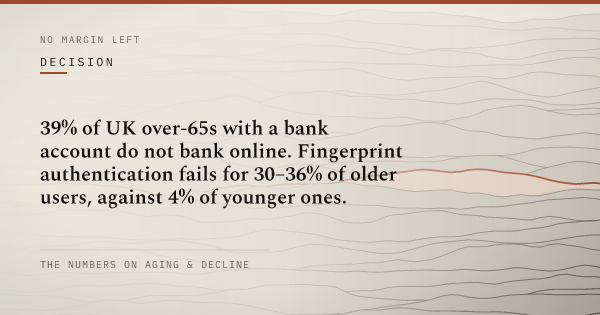
Digital banking security is built for the median user and excludes the old one. The remittance-dependent expat is the profile it locks out at 80. With the fix.
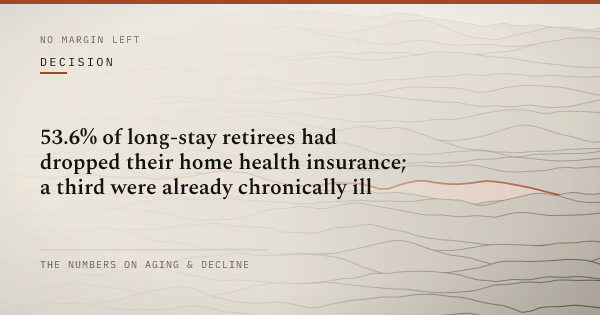
The quiet form that ends your home health cover. One residence deregistration converts a retiree to full private-pay, and in two systems the door never reopens.
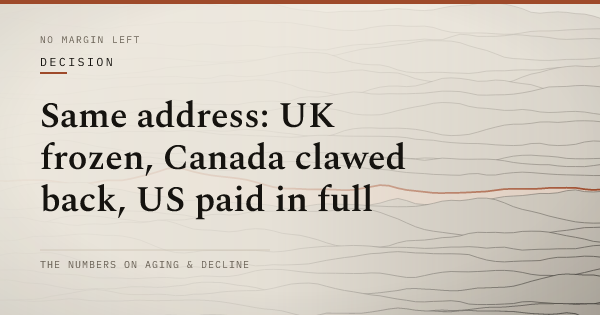
One Thailand address freezes a UK pension, claws back a Canadian one, proportions an Australian one, pays a US one in full. The passport decides, not the place.
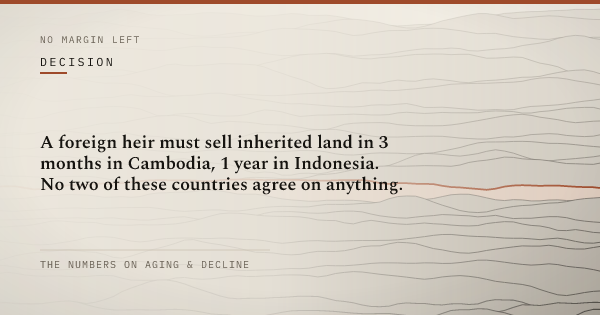
Thailand, the Philippines, Vietnam, Cambodia and Indonesia release a deceased's estate five different ways: probate, freeze, forced heirs, the property clock.
Thai probate is mandatory even with a valid will. Banks freeze on death and release nothing until a court appoints an administrator — 4 to 12 months. The freeze-to-release timeline, costed.
Bangkok Bank froze address-only foreigner accounts in May 2025. Barclays UK closes "address abroad" personal accounts. ABA Cambodia tags US-person non-compliance as recalcitrant. The bank-by-bank survival table.
A 5-year visa, no insurance, THB 500,000 in the bank. The YouTube channels do not show the tax, the banks, the activity gate, and the renewal at year 5.
A power of attorney executed after cognitive decline begins is contestable, not valid. The cross-border instrument × jurisdiction × capacity-rule matrix, with the Shulman finding that the lucid-interval defence in dementia is medically void.
Thailand has asked for 65,000 baht a month since November 2008 and never changed it. Priced in five home currencies, the frozen number moved for everyone.
IPMI shuts down. The Non-O extension drops the insurance requirement. The reserve a self-insurer has to keep liquid is the price the brochure never wrote down.
What the Philippine Retirement Authority actually did on 1 September 2025 — categories collapsed, deposits raised, age dropped, and the peer-program floor after Malaysia tightened first.
Thai tax residence turns on a calendar count, not a status. The 180-day threshold, the day-counting rule, the three responses to it costed honestly.
A foreigner can buy the house and never own the land under it. What each workaround signs away when the marriage or the law turns, costed.
Conventional planning stress-tests against a market crash. For an aging expat the plan-ending shocks are certain and permanent: cliff, care tail, freeze.
A monthly cost figure is the wrong tool for a 25-year retirement. The reproducible 7-step method for your own year-the-margin-hits-zero, levers ranked.
Every retire-abroad checklist is built to clear you to go. This one can return 'no': four solvencies, financial to exit, scored on 25-year survival.
The '$10,000 SRRV' every guide quotes was abolished in September 2025. What the restructured visa now costs to enter and hold, by age, sourced.
The 65,000-baht income rule is pre-tax, single-person, and cheapest-city, and the qualifying remittance is itself the taxable event. Modelled by FX.
Average UK rent alone is about 131% of the full state pension. 'I'll just go home' is the fallback nobody costs, and its price rises every year abroad.
Thailand's 2024 remittance tax treats pensions differently. A double-tax treaty decides whether yours is assessable at all, by its character, not its size.
Philippines and Thailand reality files.
The Local Government Code runs to 536 sections and never says ambulance. What the instruments in two countries actually oblige, and who is left holding it.
Thailand guarantees emergency care for 72 hours. A program refused 11,776 of 20,206 requests, and the money comes from the scheme the patient belongs to.
The Philippines lets a foreigner into PhilHealth at ₱15,000 a year. But case-rate ceilings cover a sliver of a catastrophic bill, and foreigners are barred from the Z packages.
Healthcare is cheap here means the local universal system. In five of six SE Asian destinations it is closed to the foreign retiree. Only PhilHealth admits you.
Malaysia's MM2H visa once opened at RM10,000 a month. The 2021 spike and the 2024 Silver/Gold/Platinum tiers priced out that retiree. The before/after, traced.
The head-to-head for growing old, not visiting: a frozen UK pension vs an uprated one, a baht-fixed visa vs a dollar floor, deeper hospitals vs a faster medical trend. Sourced.
Numbeo single ex-rent USD 627.70, no statutory retirement visa, US Social Security restricted to embassy pickup, cardiac evacuation to Bangkok as the standing plan. The 2026 cost-of-aging file on Cambodia.
Numbeo says Denpasar is the cheapest of the SE Asia capitals. The medevac is Singapore, the seismic floor is 547 quakes in 2025, and the legal floor is the firing squad. The actuarial reality of Bali, dated and sourced.
HCMC is the cheapest of the launch cities on the daily basket and the structurally hardest to age in. The slow VND tailwind does not save it. The visa stack, the frozen UK pension and the friction stack do the work.
Vietnam is the only ASEAN-6 mainland country without a statutory retirement visa. The realistic stack costed honestly, plus the 2028 sunset risk no one mentions.
A ฿1,200 night out in Pattaya, the same evening in pesos in Angeles. The daily number is small and true. Compounded over ten years, here is the six-figure total the daily number hides — and the health cost beside it.
The cheap-living city and the best-care city are not the same one. Bangkok vs Chiang Mai on the access dimensions that decide outcomes with age — and the transfer.
Cebu has good hospitals. All seven of the Philippines' JCI-accredited facilities are in Metro Manila. For the rarest emergency at the worst age, the gap is the plan.
Bangkok has the highest retiree baseline of the four launch cities and Asia's best private hospitals. Run as a 25-year trajectory, that combination is why the money runs out faster here.
Chiang Mai sells the lowest burn in the brochures, near $1,500 a month. The honest figure is the crossover age — a frozen pension and a flat baht pull it in.
Manila is the most expensive of the launch cities, about US$200 a month over Cebu. Run the trajectory to the year the margin hits zero — and what the premium buys.
A single retiree can live in Cebu City for about $1,400 a month. That number is real, and it has an expiry date. The Cebu cost-of-aging trajectory, run to the year the margin reaches zero.
Nothing matches that. Clear the filter, or search the full text.