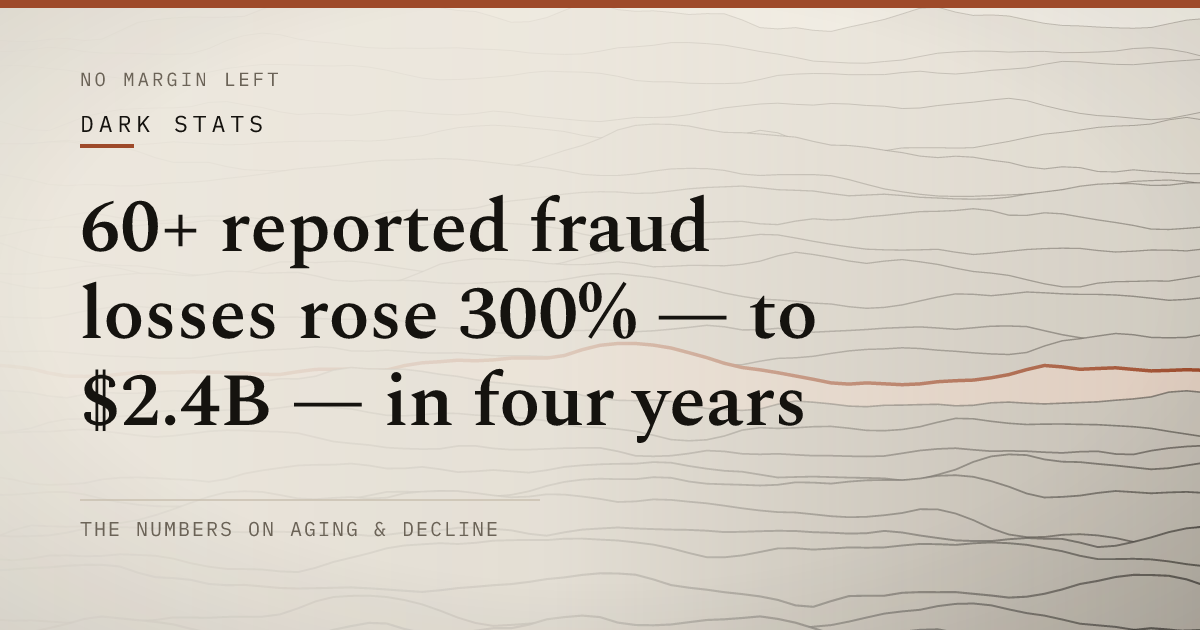
Start with the line. In 2020, US adults 60 and older reported losing about $600 million to fraud. In 2024 they reported losing about $2.4 billion. The FTC’s own report, its eighth annual filing to Congress on protecting older consumers, does the arithmetic and names it in plain words: “a 300% increase.” Four years, and the number quadrupled.
The intermediate steps are not noise around a flat average. They are a climb. Roughly $1.0 billion in 2021, $1.6 billion in 2022, $1.9 billion in 2023, $2.4 billion in 2024. Every year up. This is the central ledger of the piece, re-verifiable and dated, because the trend is the thing the relocation pitch will never put next to the arrival footage.
| Date | USD, billions | Basis | Note |
|---|---|---|---|
| Date 2020 | USD, billions 0.6 | Basis sourced | Note ~$600M aggregate reported fraud loss by adults 60+ (FTC Figure 1: $306M under $10K + $218M $10K–$100K + $76M over $100K). The base year of the 300% rise. |
| Date 2021 | USD, billions 1 | Basis sourced | Note ~$1.0B (FTC Figure 1: $584M + $341M + $100M). |
| Date 2022 | USD, billions 1.6 | Basis sourced | Note ~$1.6B (FTC Figure 1: $1.0B + $482M + $101M). |
| Date 2023 | USD, billions 1.9 | Basis sourced | Note ~$1.9B (FTC Figure 1: $1.3B + $566M + $105M). |
| Date 2024 | USD, billions 2.4 | Basis sourced | Note ~$2.4B reported by 109,580 of 421,031 age-tagged 60+ reports. FTC: "a 300% increase" over 2020. Driven by >$100K losses (up 351%, 5% of reports / 68% of dollars). FTC's own estimate of the TRUE cost, adjusting for underreporting, is $10.1B–$81.5B for 2024. |
Source: FTC, "Protecting Older Consumers 2024–2025" (annual report to Congress under the Elder Abuse Prevention and Prosecution Act), Figure 1, citing the Consumer Sentinel Network · latest 2.4 USD, billions (2024) · as of 2026-09-04
Every figure here is as of the FTC’s Protecting Older Consumers 2024–2025 report (December 2025), and each drifts with the annual release.
A single caveat governs every figure that follows, and it cuts in the dark direction. These are reported losses, not estimated total losses. The FTC says the vast majority of fraud goes unreported (the research it cites found that only about 4.8 percent of mass-market-fraud victims ever complain to a Better Business Bureau or a government entity), and the agency’s own estimate of the true 2024 cost of fraud to older adults, adjusting for that silence, is between $10.1 billion and $81.5 billion. The $2.4 billion is not the figure. It is the floor.
Reported is not actual, and the gap is the point
People do not report being robbed. They are ashamed, they do not know who to tell, they do not realise it was fraud, or they are no longer able to. So the Consumer Sentinel Network catches the few who come forward, and the agency reasons up from there to a range that is, at its top end, thirty-four times the reported number. The honest way to hold every figure in this piece is as a visible edge. The water under it is deeper than the line on the chart, and no one knows by exactly how much — the FTC says so itself, calling the scale of underreporting “not well understood.” When losses are large, underreporting is worse, because a person who has lost a six-figure tranche has the most reason to say nothing.
That is the first thing the dream-sellers omit. The second is age.
The loss gets worse the older you get
The trend is one axis. Here is the other. In 2024 the median individual reported loss did not sit flat across the older cohort. It climbed with every band.
Source: FTC, Protecting Older Consumers 2024–2025, Figure 2 · checked 2026-06-05
Read it from the bottom. A person in their twenties who reports a fraud loss reports a median of about $417. The figure barely moves through the working years. Then it bends. $691 in the sixties. A thousand dollars flat in the seventies. And $1,650 once past eighty, more than three and a half times the twenty-something’s loss, and far above every other band on the chart. The combined 60-plus median was $900 in 2024, up from $650 the year before. The number is not only high. It is rising.
The instinct is to read this as older people are gullible. The data says the opposite, and the correction matters because it changes what you do about it. Older adults report a loss at a lower rate than younger adults. About 74 percent of the fraud reports filed by the 60-plus indicated no money lost at all; adjusted for population size, the cohort was about 13 percent less likely to file a loss report and 62 percent more likely to file a no-loss report: the report of a scam spotted and refused. They get targeted constantly. They mostly say no.
So the threat is not frequency. It is conditional severity: the size of the loss given that a loss happens, and that severity slopes upward with age. The older you are, the rarer the successful hit, and the larger it is when it lands.
The tail is the whole story
What pulled the line up 300 percent was not a broad drizzle of small losses getting slightly bigger. It was the catastrophic individual hit becoming more common.
Those six-figure reports were only 5% of older adults' loss reports — but they carried 68% of the money. From 2020 to 2024, combined losses by the 60+ who reported losing over $100,000 rose 351%, more than fivefold. Population-adjusted, older adults were nearly twice as likely as younger adults to report a six-figure fraud loss.
That is the engine. A small number of devastating losses (the emptied retirement account, the liquidated investment, the house deposit wired to a fake platform) account for more than two-thirds of every dollar the cohort reported losing, and that category grew more than fivefold in four years. The median tells you the typical hit is climbing with age. The tail tells you the ruinous hit, the one that ends a retirement in a single afternoon, is climbing in frequency. Both curves point the same way, and both point at the person with the most to lose and the least time left to rebuild it.
The scams doing the heavy lifting are not the petty ones. By total dollars lost in 2024, the 60-plus cohort’s worst was investment fraud at about $744 million, up 38 percent: typically a fake cryptocurrency platform reached through social media. Then business impersonation ($377 million), government impersonation ($375 million, up 47 percent), and romance scams ($329 million). These are the long, patient, relationship-built frauds, the ones that work by manufacturing trust over weeks, not the crude one-shot calls.
What is actually moving the line
The 300 percent is a composite of several curves, and it is worth pulling them apart, because the components are growing at very different speeds and the fastest ones point straight at the relocated reader. Look at where the contact starts. Reported losses to fraud that began on social media rose nearly ninefold for the 60-plus since 2020, the single largest source of both reports and aggregate dollars. Text-message fraud rose more than eightfold over the same window. The growth is not spread evenly across an old man’s day. It is concentrated on the screen.
And look at how the money leaves. The two costliest payment methods by aggregate dollars are bank transfer, where reported 60-plus losses rose more than eightfold since 2020, and cryptocurrency, where they rose more than twentyfold. Crypto is the fastest-growing rail in the entire dataset. Both are push payments: irreversible, near-instant, and final the moment they clear. There is no chargeback on a wire, no dispute window on a coin sent to a stranger’s wallet. The scam types that grew the most are the ones that route money through the rails that cannot be undone.
There is one more curve, quieter and worse. The loss is often discovered late, by someone else. About 16 percent of the reports filed for people 80 and over were submitted by a third party (an adult child, a spouse, a caretaker), a far higher rate than any younger group, and those third-party reports carried higher median losses than the self-reported ones. The pattern is plain. The biggest losses, in the oldest band, surface when somebody else finally notices, which is to say after the account has already been drained and the person who held it could no longer see what was happening. A loss discovered by a third party is, by definition, a loss the victim did not catch in time.
Why the isolated expat is the target profile, not a footnote
Here is the part the relocation channels will not run, because it does not photograph and it implicates the move itself.
The FTC report, read for mechanism rather than headline, is a description of the conditions under which a large fraud loss happens. Cross those conditions against the structural position of a Western retiree who has relocated to Thailand or the Philippines, and they do not merely overlap. They are the same person.
Take the payment rails. The FTC’s costliest payment methods by aggregate dollars are bank transfer and cryptocurrency. Since 2020, reported 60-plus losses rose more than eightfold on bank-transfer scams and more than twentyfold on crypto. Now ask what an expat’s financial life runs on. A cross-border pension and savings, moved by international wire and increasingly by crypto rails because the banking is awkward, with no familiar branch teller who has known him for twenty years and might pause a strange transfer. The remittance-managing retiree lives on precisely the rails the report names as most dangerous, and he has removed the human circuit-breaker that sits, unnoticed, inside a domestic banking relationship. The mechanics of moving a pension across a border are also the mechanics of moving it to a scammer, and the same friction that makes the first annoying makes the second easy.
Take the contact methods. The highest aggregate losses started on social media; the highest median loss, $2,210, came from fraud that began with a phone call. The phone was the dominant contact method for the 80-plus, the band where the median loss is already $1,650. Social media and the phone are the contact surface of a person who lives alone. Isolation is not a sad backdrop here. It is a risk factor with a number attached, because the second pair of eyes that interrupts a fraud, the spouse who asks why you are wiring money to a stranger or the adult child who happens to call mid-scam, is exactly the scaffolding the move removes. The relocation pitch sells solitude as serenity. The fraud data prices it.
And take age itself. The 80-plus median is the highest, third-party reporting is the highest, and the severity is the highest — the convergence of cognitive vulnerability, isolation, and a lifetime’s assets in one account. This is the same structural exposure that shows up in who actually robs the aging expat: the danger concentrates not on the careful stranger you can spot but on the person (or the platform) with access, at the moment your capacity to oversee that access is declining. Fraud is the external version of the same vector. Cognitive decline alone abroad is the internal one. They meet on the same account.
None of this is a measured expat figure. None. The FTC counts reports filed in the United States; it defines older adults as the 60-plus under the Elder Abuse Prevention and Prosecution Act, and there is no published fraud-loss rate for Western retirees in Southeast Asia. Inventing one would be the exact fabrication this work exists to refuse. What transfers is the magnitude, the trend, and the profile — and the profile is not a stretch. The report’s composite high-risk subject is socially isolated, managing money online, increasingly cognitively exposed with age, on bank-transfer and crypto rails. That is the relocated expat by construction, the day he lands.
The decision, before the window
The pattern decides the response. A threat that is growing on the calendar and worsening with age is not met by vigilance, because vigilance is exactly the faculty the 80-plus median measures the erosion of. You cannot out-attention a fraud in the year your attention is failing. The only defence that survives your own decline is one you built before it.
That makes the safeguard structural and pre-decline. Not “watch out for scams”: the checklist every fraud-prevention page ends on, and the one that fails precisely when it is needed, because it asks the victim to be sharp at the moment the data says they will not be. Structural means the account itself resists a single isolated decision. Transfer limits and out-of-band confirmation on the cross-border account. A second signer or a trusted monitor for large movements. A bank relationship that flags anomalies rather than one that processes them silently. A power of attorney decided while capacity is intact rather than improvised after it is gone. The point of each is the same: to put a non-self observer back into the loop the move took out, so that no single person, including a declining future version of yourself, can move a six-figure tranche unwatched.
This is the same logic the bank-account survival work applies to compliance and access. Here it applies to fraud. The retiree who treats fraud as a frequency problem (I am careful, it will not be me) has misread his own data. He is careful, which is why his loss rate is low. But he is isolated, remittance-managing, and aging into the band where the median loss is $1,650 and the tail is fivefold heavier than it was. The frequency is not the exposure. The severity is, and the severity is structural.
The line on the chart goes up 300 percent over four years, and that is only the part anyone reported. The median climbs with every decade of age. The costliest rails are the ones a pension crosses a border on, and the highest-loss contact surface is the phone of a man who lives alone. The expat did not wander into the worst cell of this table. He moved into it, on purpose, and called it a fresh start. The safeguards have to be built before the year the figure was always going to find him.